Search This Blog

Showing posts with label sustainable agriculture. Show all posts

Monday, October 25, 2010

Do you know the way to San Jose?

I am just back from an academic conference on environmental justice and sustainability in San Jose, California at Santa Clara University.  It was a really interesting conference and I got to meet a really interesting woman in my field, which is always a treat.  But this was, after all a conference on sustainability and that means there was some talk about food and sustainability.

The food served at the conference was, by and large, either quite good or typical conference fare.  The first afternoon at the conference started with a cocktail party with some passed hors d'oeuvres, your standard cheese and cracker plate and crudites.   Dinner was lovely, and I was assured by the people who worked for Santa Clara that much of the food really was sustainably grown (although I have my doubts about the chicken and the chocolate).

But I do have two moments from the conference that are both more important than the food or my doubts from the first dinner.  One has to do with the conference topic and presentations the other has to do with lunch on day two. 

Lunch on day two was a soup and salad buffet.  I like buffets since you can make your own choices about what to take and how much to take.  The salad was separated into individual bowls--lettuce in one, carrots in another--you get the idea.  It was pretty much sesame chicken salad.  I chose judiciously--only what I wanted to eat and only as much as I wanted to eat.  I skipped the soup, even though it looked pretty good.  But as I was finishing what I took one of the conference organizers, with whom I had dinner the night before mentioned that I hadn't eaten much--but I had eaten all I wanted and was full.  No need to take more than I needed.  Waste is not sustainable.  I don't mean to be critical.  She did not mean anything insulting by it.  Rather, I expect she was trying to be a good host--hospitality is a key trait of Jesuit communities and schools.  But it did stick with me.  Often we push food on others as a sign of hospitality and I am sure that in earlier times it made more sense than it might now.  But I am going to try to do less of this myself since it encourages overeating or waste, neither of which is good!

The other thing has to do with some discussions about food and sustainability as content of the conference.  Santa Clara has a garden to teach their students and others about food and the environment.  We are starting a garden here, too--the raised beds went in earlier this month.  They also do outreach into parts of their community to discuss and try to alleviate food deserts which are getting more and more prevalent in urban centers.  But the main focus of environmental justice, something I teach about in some of my classes, has really got my wheels turning.  How can I work this idea into my food ethics research?  I'm getting ideas.  this is not what I expected from my time at this conference.  I expected to go, asked to be the leader of the delegation from my school, and that was it.  But by taking the opportunity seriously, I got some food for thought, too.

Thursday, July 29, 2010

Setting Broken Limbs


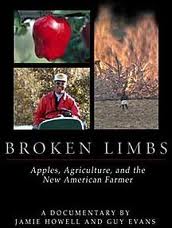
Today I watched the documentary, Broken Limbs, once again. I always show it in my food ethics class. It is important to show because it puts a face on sustainable, local agriculture. Made a few years back by a Wenatchee, WA native, it is about the apple industry in Washington state and how it has changed in a single generation.

It used to be that in Wenatchee, dubbed "the apple capital of the world" a five acre orchard could support a family and now that is unusual. Farmers are pulling out apple trees because they just don't pay the bills anymore. They have to try something new, something different if they are to stay small and stay in business.

Students usually respond positively about the film and not only because many of them are from the Wenatchee area or know someone who is (this year one student said that if the footage had been from the 2004 instead of 2003 Apple Blossom Parade she would have been on the float). But since it is local to us here in Washington state I do think it hits home in a different sort of way.

I grew up on the East coast knowing about Washington apples and believing they were good apples. When I first moved to Washington state and heard the governor on the news talking about trade agreements with New Zealand which included apples I thought it was pretty silly. Aren't apples naturally something that can be held over the winter? Or at least a good chunk of the winter? A new crop apple in February is something you know isn't locally grown around here.

There are two parts of the film that touch my heart every time I see it. When the farmer, losing his land, talks about how hard it is as his wife tears up and when the man making the film starts to help his dad on his land and to see the importance of farmer. He describes himself as the broken limb, since he did not want to go into the orchard like his father, grandfather and great-grandfather.

And there are two parts that give me hope every time I see it, too. When Ikerd, who is interviewed explains the purpose of agriculture--to make people's lives better and the triple bottom line of sustainable agriculture--that is needs to be sustainable for the environment, for the farmer (i.e., profitable) and for the people in the community and when small farmers who are sustainable are interviewed and say that they are happy to share what they know with others.

Being able to eat ethically once again is something that starts slowly. It used to be the only way to eat--there weren't big businesses involved as there are today. This isn't to say all business is bad, but that once we became disconnected from the food system we eat in, eating unethically, because we ate unknowingly became a possibility. As people try to get back to methods that are sustainable and eaters demand that of their food system we have hope that we can, bite by bite, make a better choice and a better world. My apple a day will be a Washington apple for as long as I live here--that's my bite into the better world.